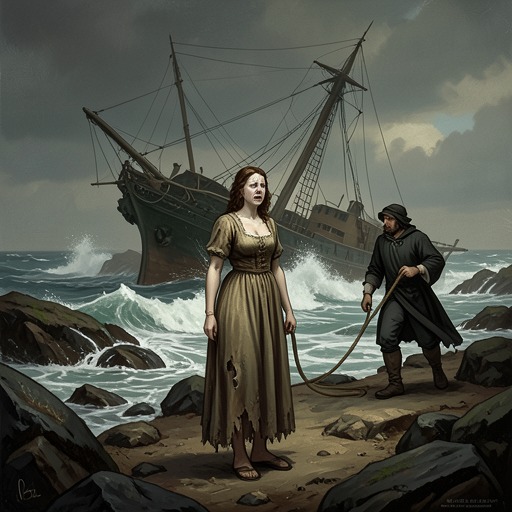
Alatiel
The DecameronAlatiel is the exceptionally beautiful daughter of Berminedab, whose intended marriage to the King of Algarve becomes a story of shipwreck, displacement, and return. Sent across the Mediterranean as both a bride and a sign of her father’s gratitude, she survives a chain of upheavals that repeatedly strips her of control over where she lives and whom she is made to marry. Her eventual restoration depends not on reversing that history, but on concealing it and giving her a socially acceptable place within it.
Identity and Intended Marriage
Alatiel’s beauty is introduced as the quality that makes her famous and shapes her fate. Berminedab gives her to the King of Algarve after that ruler has helped him defeat a great force of Arabs. He sends her by sea with an honorable company of men and women and a rich provision of furnishings and possessions. The arrangement presents her as a royal bride and a diplomatic gift, entrusted to a carefully equipped voyage.
The story also frames her beauty as a source of misfortune. Its narrator says that, within roughly four years, she was married anew nine times. That account makes her successive changes of household part of the central irony: the beauty that first makes her a prized bride exposes her to repeated loss, capture, and transfer. The episodes preserved here show only some of those reversals, rather than recounting every marriage in the larger sequence.
Shipwreck and Successive Captures
The voyage from Alexandria proceeds well after the ship passes Sardinia, but a sudden storm turns the passage toward disaster. For two days the sailors struggle against the sea. On the third night, with the ship leaking and the sky obscured, the officers and then the other men crowd into a shallop. The overloaded boat founders, and all who have left the ship perish. Alatiel and her women remain aboard, overcome by the storm and fear; the battered vessel eventually runs aground on Majorca.
A later episode finds her in Chios with Constantine, who has taken her away and is living with her as his mistress. Osbech, King of the Turks, hears of their presence and attacks the city by night while its inhabitants are asleep. His forces take captives and booty and burn the place. Finding Alatiel among those captured, Osbech recognizes her from the raid and makes her his wife; they live together for some months. Her movement from one ruler’s intended marriage to Constantine’s household and then to Osbech’s is presented as a succession of abrupt changes imposed by political violence and circumstance.
Disclosure and Return
Alatiel’s route home begins when she encounters Antigonus of Famagosta at Baffa. Recognizing in him a figure who reminds her of her father, she chooses to disclose the history she has kept hidden. She asks him either to find a way to restore her former position or, if he can see no remedy, to keep their meeting secret. Her account turns her from an apparently lost woman into a royal daughter whose identity can be acted upon.
Antigonus promises to return her to Berminedab and then to the King of Algarve. He appeals to the King of Cyprus for help, presenting Alatiel as the Sultan’s daughter, long believed drowned, and as a woman who wishes to return to her father. The king agrees, receives her with honor at Famagosta, and sends her onward under Antigonus’s protection with a distinguished company. The same generosity extends to the final stages of her restoration: Berminedab rewards Antigonus, thanks the King of Cyprus, and contacts the King of Algarve so that the intended marriage may be completed.
Reinvention and Narrative Irony
Alatiel’s return does not involve a full public acknowledgment of what happened to her. Antigonus tells Berminedab that Alatiel has recounted the same history to him, but supplies an additional account of her supposed chaste and modest life among religious women. This claim contradicts the sexual history the story has just related. It is a deliberate cover that allows her father to welcome her without confronting that history and permits the original marriage arrangement to proceed.
The King of Algarve receives Alatiel joyfully, and she is presented to him as a virgin. The ending thus makes restoration depend on a false public account rather than on the recovery of an untouched past. Alatiel’s story joins the hazards of maritime travel and political capture to a sharp narrative irony: the social identity that secures her return is produced through concealment, while the beauty that first marked her as a valuable bride has also accompanied her repeated displacement.